SO WHAT DOES WORK?
We’ve seen that traditional methods for choosing a career are, at worst, inherently flawed, and at best, incomplete.
What we need is a new lens through which to view our career and our life path. What we need is a new method and a new framework.
We need a method that
1) Allows for real life experience and exploration instead of simple guessing (i.e., allows “dressing rooms” instead of just Internet shopping);
2) When necessary, minimizes the risk of betting big by allowing us to try on jackets without the necessity of “going all out” right off the bat;
3) Allows us to discover unforeseen, previously inconceivable opportunities that we otherwise would not have been exposed to (i.e., opportunities that don’t show up at the top of our Google searches);
4) Places at least as much emphasis on the self (the company) as it places on the specific job or career (the product).
This is precisely the method that this course is aimed to help walk you through. Because as it turns out, there’s a better, TRUER way to discover the work you were built to do and the life you were meant to live.
Consider this: Of almost ALL the happy, successful, fulfilled individuals who I’ve talked to and interviewed over the years who are passionate about their work and their lives, most of them started off just as lost as you or I– wondering what they were meant to do with their lives, seeking a sense of passion and purpose and direction, and having no idea where to start.
And, knowingly or unknowingly, almost all of them found their way INTO their current paths by using some semblance of a process I like to call E & E, or “Experimentation and Evolution.”
The remainder of this course is designed to teach you the ins and outs of the E & E process so you can make it work for you and for your situation, regardless of what it might look like.
If you’re a student or a recent graduate who has no clue what to do with your life, E & E is for you.
If you’re employed full time but itching to find work that’s more fulfilling and that you’re more passionate and excited about, then E & E is for you.
And if you’re in between jobs or unemployed, then this method is for you, too, although it’s admittedly more difficult to apply for immediate results (this is because it’s a method that helps you find your way over time, not immediately, which I’ll explain in more in Module 2).
Over the course of the next seven modules, I’ll show you HOW to experiment and evolve your way into the answers you seek, revealing the truest answers I’ve found yet– many of which are skipped over by most “career experts” out there who teach only the conventional methods of strength/interest assessments, resume building and interviewing.
Although there’s no doubt that these conventional methods can be important pieces of the process and aren’t to be ignored (and in fact, I cover some of these aspects within the course, particularly within Module 6), the truth is that they simply don’t get to the heart of the matter: In order to truly find our way, we need to do more than just keep playing harder at the same old rules.
Instead, we need to make a fundamental shift in the way we look at and approach our careers and our lives. We need to shift our view to one in which we can experiment, explore, and evolve our way into the answers we seek rather than trying to think or strain ourselves into the answers forcefully. One in which we experience the magic of learning experientially (by “doing”) rather than simply learning in the classroom. One in which we realize that the path we will walk is not a straight line from point A to Point D, but rather a “messy, ugly-beautiful scribble”– a process that never ends, but one that we can walk and navigate with more purpose and direction than we’ve ever imagined if we’re able to integrate the guidance taught within this e-course.
The basic tenets of the E & E process are as follows:
- Despite popular belief that you must pinpoint your exact destination (or desired career path) in order to end up somewhere great, it is in fact best practice to “go on a Knowcation” and allow yourself to start from a place of not knowing. It is from a place of questions and of curiosity that our truest solutions are allowed to surface.
- From this place of not knowing, we find our way into our truest paths not so much through thinking and analyzing and assessing, but primarily through doing– through exploring, experimenting, and trying new things. (I’ll show you exact ways to do this and places to start by taking small steps and without necessarily Internet shopping with all you’ve got.)
- Through purposeful and conscious experimentation, we can then evolve our way into our truest paths and our greatest selves without knowing from the beginning our exact destination. (I’ll show you specific methods to help you evolve consciously and deliberately rather than willy-nilly.)
- Lastly, the evolutionary process of finding our truest career & life paths often happens slowly over time rather than all at once. It is a never-ending, continually unfolding lifelong process.
SCIENTIFIC & RESEARCH-BASED SUPPORT FOR THE E&E PROCESS
![There's lots of scientific evidence backing up the methods of this course! [Image: [martin]]](http://kewlpeople.theunlost.com/wp-content/uploads/2013/03/scientist.jpg)
There’s lots of scientific evidence backing up the methods of this course! [Image: [martin]]
Successful career transitions rarely begin with a clear objective
In her 2003 landmark study of career transitions, Professor Herminia Ibarra listed the following among her key findings about how career transitions unfold:
- Take two to three years
- Not a linear process
- Rarely driven by a clear objective
- Process by which the old becomes less appealing while the new gains contour
- Gradual escalation of commitment to investments outside one’s company
- Momentum based
Each of these findings fit in with the foundational concepts of this course. Of particular interest is the finding that successful career transitions were “rarely driven by a clear objective.” This sounds so counter intuitive! After all, how can we discover and pursue a career path without having a clear idea of the exact destination and objective? That is what I’m here to teach you.
Professor Herminia Ibarra presents a new model for career reinvention that flies in the face of everything we’ve learned from “career experts.” While common wisdom holds that we must first know what we want to do before we can act, Ibarra argues that this advice is backward. Knowing, she says, is the result of doing and experimenting. Career transition is not a straight path toward some predetermined identity, but a crooked journey along which we try on a host of “possible selves” we might become.
– From the Amazon book description: Working Identity: Unconventional Strategies for Reinventing Your Career by Herminia Ibarra
Experimentation & exploration as effective methods for finding passions and interests
In the spring of 2000, Professor Linda Caldwell and her research team at Penn State University administered tests to a group of junior high school students– tests that measured how students used their free time. The researchers found that all of the students in the study exhibited low levels of interest and passion— in other words, they hadn’t yet discovered passionate work or pursuits.
A year later, however, the tests were administered to the same group of students, with results that were significantly different. Within the timeframe of a year, a subset of the students now had much higher levels of interest and lower levels of boredom. They had “gravitated toward things they really liked; they were more likely to take initiative and start new projects; and they were skilled at transforming free time into something productive or exciting.”
The only difference between the two subsets of students was this: those who became more “interest-prone” as described above had been taught to explore and experiment during their free time, whereas the others had not.
During your free time, Caldwell says, “You need to be exposed to many things— you should expose yourself even though you might not know if you’ll be interested: find out about and attend events on the local college campus and in your community, and ask yourself, ‘Did I enjoy this?’”
The main takeaway here is this: your “passion” or your career path is not something that you can select just by going through a pre-existing list, determining what looks interesting, and then meticulously selecting your pursuit. This is the way most people operate, and yet they often end up unhappy in their chosen pursuits.
Instead, in order to discover a true deep interest, you need to immerse yourself. You need to go out and actually expose yourself to many, many things— things that you may have no idea beforehand whether they will interest you or not. Then, when one of these things does capture your interest, you should continue to follow up on it and see where it leads you. Quite often, it will lead you toward something that you never could have predicted in the first place— not by “brainstorming,” not by choosing from a list, and not by taking a strengths assessment.
Career transitions/discoveries & the evolutionary process
As noted in the introduction to this module, I like to spend my free time studying successful companies and reading books like Built to Last: Successful Habits of Visionary Companies, in which– through a carefully designed six year research study, the authors identified the differentiating factors between enduring great companies and those that failed to become great.
And because I’m a weirdo, I like to draw comparisons between building great companies and building great careers (evidence of which you’ve already seen!). Guys, there are far more meaningful similarities than you could imagine.
One of the most important similarities I’ve discovered is that when making career transitions (or when making a new career discovery from scratch), successful people use a very similar process to the process that great companies have used time & time again to find their way into their (eventual) pursuits.
In Built to Last, the authors explain something they call evolutionary progress. They explain how the great company Johnson & Johnson began life as a supplier of antispetic gauze and medical plasters (not the consumer household products such as baby powder and shampoo, which they’re famous for today).
J. Willard Marriott, the founder of Marriott hotels, began life with a root beer stand, and eventually evolved his way into the hospitality industry, something totally and completely different.
And as I recounted in the intro of this module, Hewlett & Packard began by experimenting with many product ideas– from automatic urinal flushers to bowling foul-line indicators to fat-reducing shock machines– before finding their way into the computer business.
As the authors explain:
What should we make of these examples? J & J accidentally stumbling into consumer products? Marriot accidentally stumbling into airport services? American Express aciidentally becoming a financial services powerhouse? We might be tempted to just ignore them as weird abberrations, but they weren’t the only examples we had. Bill Hewitt told us that HP never planned more than 2 or 3 years out during the pivotal 1960′s. Of course they BUILT for the future, but that’s very different from planning. Nor did the company have any grand plan in mind when making its watershed strategic move into the computer business. Quite the opposite. In 1965, HP designed its first small computer with the simple objective to add power to its line of instrument products.
Don’t get us wrong: we’re not saying that these companies never had plans. But we were surprised in our research to find so many examples of key moves that came about by some other process than planning. Nor did these examples merely represent random luck. No, we actually found something else at work– [evolutionary progress.]
Evolutionary progress is unplanned progress.
We can make our way into fulfilling career & life paths similarly: by taking advantage of the E & E method I’ll be teaching and using the forces of unplanned, evolutionary progress to our advantage.
We don’t have to know exactly what we want to do or be “when we grow up”– we simply need to take experimental, evolutionary steps, following the proven E & E model, and we’ll inevitably be participating in a process that will take us toward our greatest potential and our highest selves. This is how we reinvent (or invent) our careers.
Reflection, connection and journaling as an important part of the process
In addition to taking a “Knowcation,” experimenting, and doing (all key pieces of the E & E process), research has also shown that it’s essential to reflect on our processes.
In the study by Caldwell described above, the exploration that junior high students were taught to do was only one aspect of their success in discovering passionate pursuits. Guess what the other aspect was? Silent reflection. The students who were taught to use their free time to explore new opportunities– coupled with ample silent time for reflection– were significantly more likely to have found passionate, interesting pursuits a year later.
Other studies have shown that subjects who were assigned to journal about one’s “deepest thoughts and feelings” regarding job loss and/or job searching (20 minutes of journaling for five consecutive days) were SIGNIFICANTLY more likely to be fully employed than the control groups– this effect was still notable even six months later:
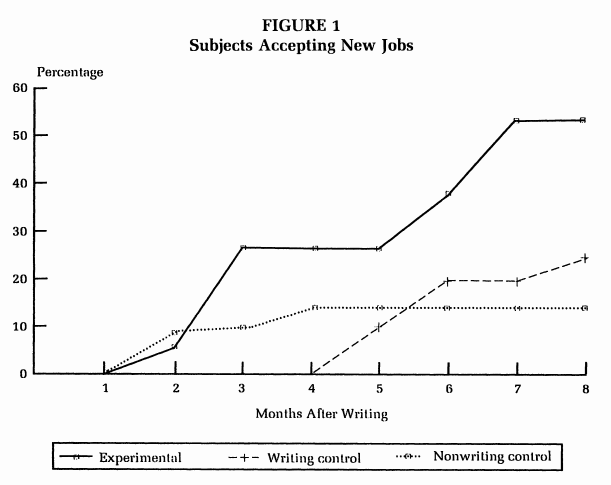
- Taken from 1994 study by Spera, Buhrfeind, & Pennebaker. Subjects randomly assigned to write about their “deepest thoughts and feelings” surrounding unemployment/job loss obtained new employment at a SIGNIFICANTLY higher rate than the control groups.
As such, I include a page for journaling within each module’s homework assignment and I focus lots on reflecting on your experiences, thoughts and feelings within your group meeting agendas (for Move-lah course members).
The point is this: While making your way through the course and the homework, remember that there is always a method behind the madness!
Trust it.
Trust me.
Trust the process!
I promise you that if you stick with this and actually implement the practices and techniques presented, you’ll already be well on your way to discovering and living your truest path.
Lastly, remember that above all, this is a safe place to come together with others who are on a similar journey and to share, connect, and grow together. Having a supportive community can make all the difference, so be sure to engage yourself fully in the community resources we’ve provided, including your small Move-lah groups, the community “Knowcation Station” drop-in sessions, and our Facebook community. Doing so will make ALL the difference, and we’re here to help.
If you’re taking the “Just The Basics” version of the course and don’t have access to the community support, I encourage you to consider upgrading to one of the full versions of the course in order to experience the most support, belonging and accountability as possible– again, it truly makes a difference! To upgrade at any time, simply send an email our way and we’ll be happy to assist.
With love,
Therese & The Unlost team
# # #
Next: Move on to the Homework section to get going on your first homework assignment!