FAILURE #3: INTERNET SHOPPING IS INCOMPLETE
[i.e., “Googling for careers”]
The third failure of the traditional and delusional “career-choosing techniques” is that, despite our obsessive Internet research, there are (perhaps infinite) options in existence that we will not, and perhaps cannot, ever discover through the Internet shopping method alone. Here’s why, by relying solely on the Googling method to find a career, we’re almost certainly missing out on career options that could be extremely good fits.
Think about it this way: let’s say you’re looking for a jacket online. You have a few ideas about what kind of a jacket you’re looking for— you know you like purple. You know you wear a size small. And you know you’re looking for a jacket that’s kinda fancy (whatever that means).
You submit a Google search with these criteria and here’s what you get:
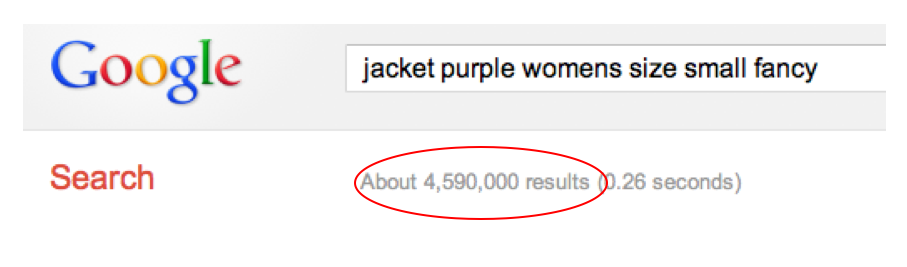
Over 4 million search results.
You’ll probably have the time and mental capacity to look through the first few pages of the search results, choosing one of the more popular jackets.
But what about all the millions of remaining jackets out there that you never even got to look at? What about all those jackets you don’t even know exist because you don’t have the time, capacity, or ability to look through all the potential options? What’s more, what about the jackets that don’t exist yet but that you might love– the ones that are still in production, the ones that aren’t even listed online, or the one that you could quite possibly create yourself? Do you think it’s likely that one of these jackets would have been a much better fit for you?
Sure, this is a silly example, but it illustrates an important point: No matter how much you Internet shop, you cannot possibly know about or think of all the available options.
When it comes to careers, the same principle holds true.
Take, for example, the story of a student named Olivia (mentioned in Cal Newport’s book, How to be a High School SuperStar). Olivia loves studying the migration patterns of horseshoe crabs, and she gets paid to do it.
How on earth did Olivia come to discover this obscure and fulfilling path of hers?
Conventional methods of searching (i.e., Internet shopping) would suggest that Olivia researched and thought really hard, trying to match up her interests and likes to an available career option.
For example, she might have searched for something like “biology major likes nature enjoys collecting data” and then thought about what sort of career opportunities matched her criteria.
But do you really think that “studying the migration patterns of horseshoe crabs” would have shown up at the top of the search page?
No way!
So if not by Internet shopping, and without a pre-existing interest in (or knowledge of) this option, how did Olivia find her way into this extremely well fitting jacket?
![How did Olivia discover her passion for studying horse shoe crabs?[Image: cbgrfx123]](http://kewlpeople.theunlost.com/wp-content/uploads/2012/08/horse-shoe-crab.jpg)
How did Olivia discover her passion for studying horse shoe crabs? [Image: cbgrfx123]
Sure, you might start by exploring the top of the Google results, because these are the things you have knowledge of and have been exposed to, after all.
But the more exploration you do and the more things you get involved with, the more new and previously unheard of ideas, professions, and opportunities you’ll be exposed to.
Most of us try to “Google” our way directly into well-fitting career paths, but the truth is that most people who love their work don’t get there directly in the way we imagine things happen.
Instead, most people get there through a process of exploration: They start by experimenting, and the successful experiments will lead them to discover new opportunities and find their way into careers and passions that they never even knew about before– things like horseshoe crab research that never would have shown up on the front page of Google.
Olivia started off having no idea what she loved to do, but on a whim, she decided to do an experiment: She decided to ask her parents’ next door neighbor, a Marine Biologist, if she could help him out over the summer with some of his research. (I call this an experiment because she didn’t know beforehand where it would lead or whether she’d enjoy it at all, but she had the curiosity and open-mindedness to “try it out and see what happened.”)
Her neighbor said yes, and before she knew it she was spending a few hours a week during the summer helping him with menial tasks and learning the ins and outs of marine biology. It tuns out that Olivia was interested, even captivated, by the research he was doing. The following year he offered her a paid position studying the migration of horseshoe crabs.
And, bing! Just like that, Olivia had found deep interest and passion in an area she had previously never even heard of: Horseshoe crab migration. And not only had she found a deep interest, but she’d also found paid work in the field and gotten valuable experience under her belt– all because she had eschewed the idea of Google searching your way directly to the end result and had instead started with a simple experiment.
This is the method that beats the conventional practice of Googling for careers every time: Rather than thinking that we should be able to Google our way directly into the results and the careers we seek, we understand that we most often find our way there through E & E, exploration and evolution.

Our truest career paths are found by branching out and evolving our way into unforeseen opportunities. [Image: Shapeshift]
In order to find our way we’ve got to stop looking only at the options around us (the Googled results) and start diving in, exploring, and getting involved. Our experiments may very well open our eyes to new opportunities and to passions just waiting to be discovered.
But in order to find these undiscovered passions and opportunities we must do, not just think. We must jump in, explore and ultimately evolve using the E & E methods I’ll teach throughout this course.
. . .
So that’s how we find our way into obscure or otherwise unknown opportunities– but what about those opportunities that don’t yet exist?
Some options might be uniquely your own.
Creating The Unlost, for example, never showed up when I Googled “career options for psychology/accounting majors.”
I couldn’t even find it on Monster.com.
So how did I experiment and evolve my way into the path I’m on now, and what career opportunities have arisen as a result?
That’s what we’ll explore in the Modules to come– and we’ll explore not only my own story, but the stories of others like Rachael Kay Albers, Ryan Coelho, and more.
Of course, no matter what our method, we’ll never have the capacity to evaluate every single option in existence. And yet even so, E & E is a far, far better way to discover well-fitting options that don’t rank at the top of Google or that don’t yet exist at all.
What unforeseen opportunities might lie ahead of you that are currently inconceivable, and how can you use The Unlost’s E & E methods to discover these options and to consciously and deliberately live your way into the infinite possibilities that lie ahead?
That’s what I’m here to show you.
# # #
Next: Move on to Section 1.4: Looking for More