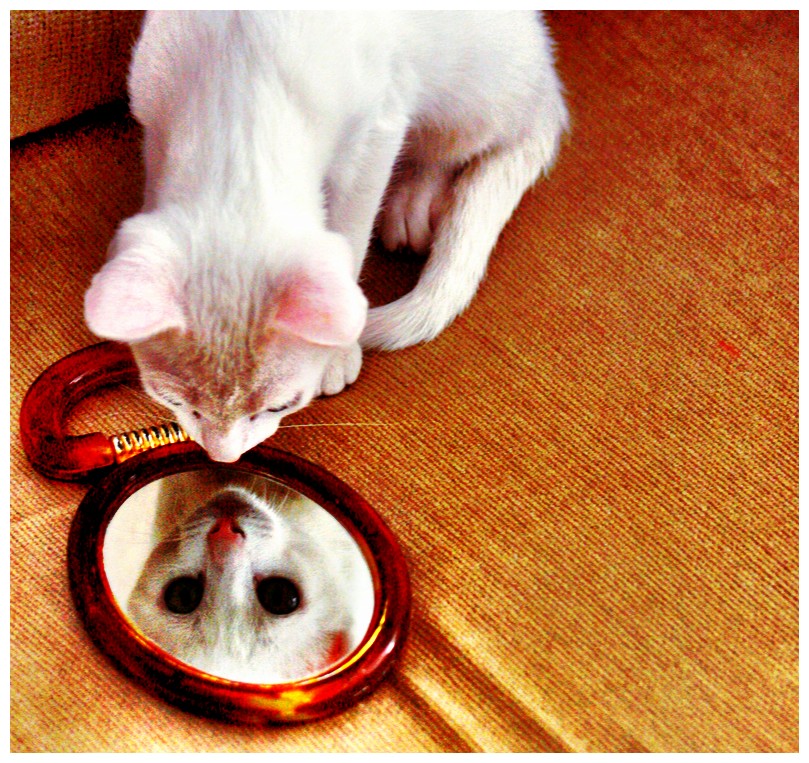
The most important group exercise of all: REFLECTIONS!
[Image source: Wagner Machado Carlos Lemes]
The following group exercises are foundational and will apply to just about all of your group meetings. In order to avoid looking like a dumb-arse, you’ll want to carefully review and become intimately familiar with these exercises prior to your first meeting. (I’d also add that the example videos are WELL WORTH watching, so I’d highly recommend making the time to watch them.)
REFLECTIONS
Reflections are an essential part of the group meetings– they’re a framework in which we can hear others, in which we can be heard, and in which we can bring forth our realness. Reflections involve listening closely to another group member and then summarizing and reflecting back what you heard.
Reflections are EASY, fun and light. In essence, we’re born with the skill to hear, but we’re not neccessarily taught how to listen. The Reflection Exercise is to help you develop your listening skills. During the process, you’ll develop the skill to quiet your mind in order to focus your attention on the speaker. This skill set empowers you to gain you friendships, open doors for opportunities, and heighten your learning capabilities, all of which will be very useful as you pursue your dreams.
Further down the page I’ll be elaborating on how to do reflections, but first let’s start with the “Why.”
Why do we do reflections?
We do reflections for a variety of reasons. Here are some of the observations that I’ve found to be true for myself:
- When I reflect on others, I gain a deeper understanding of and connection to them, and this feels really good to me. I feel like it’s something I’ve been missing within much of my everyday life.
- When others reflect upon me, I gain a deeper understanding of myself as well as a greater connection to others. Oftentimes, I come to realize new things about myself or my experience that I hadn’t been aware of before.
- When others reflect upon me with the intention of truly hearing me, I experience a new freedom to allow the “real me” to be seen, heard, and known, and this feels AMAZING!
- When others reflect upon me, I find that I often solve my own problems and come up with my own solutions effortlessly, leaving the “session” with a greater sense of clarity and understanding.
Carl Rogers, one of my favorite humanistic psychologists, noted similar observations about hearing deeply and about being heard deeply during one of my favorite talks of his. You can read a transcript of this talk right here— I highly suggest that you check it out.
How to do reflections
There are three steps to reflections: listen, summarize, and end with a question.
1. LISTEN: Focus on listening deeply and on being as present with the other person as possible– strive to listen at more of a feeling or experiential level than at a “thinking” level. The goal is to allow someone to feel like they’re really understood and heard. That said, the most important part of reflections lies in the intent. If you have a genuine intention to deeply hear and to understand someone, then you’re doing it right, regardless of how well you remember the details of what was said.
- This is not a test! Don’t worry about remembering every single detail of what was said, and instead focus on trying to understand where the other person is coming from and capturing the gist of what was said.
- Again, the MOST important thing when reflecting is having a genuine intent to really hear the other person.
- Simply sit quietly and listen. One way to do this is to imagine yourself as an inaminate object such as a mirror (I know crazy talk), but hear me out. Inaminate objects don’t think. Humans have this brilliant brain that generates millions of thoughts that potentially clutters your mind and distracts you from your surroundings, but the Reflection Exercise allows you to simply sit and listen. If you choose to pretend to be a mirror, your mind will focus and quiet itself. You have nothing to think about or worry about because your intention is just to sit quietly in order to hear. You will be amazed at how much you retain in this relaxed state of being. You are now a listener and absorbing at an incredible rat e:-).
2. REFLECT: When the other person is done talking, briefly summarize, or reflect upon, what you heard him or her say. To reflect means to bounce back what you hear.
- Begin your reflection by saying something like “What I heard you say was…” or “It sounds like…”
- The object of the exercise is not to memorize every detail that your heard. You are simply to repeat what you heard. If you only heard one thought, share it. A good reflection is not about “getting everything;” it’s simply about having the intent to truly hear someone. If you aren’t sure that you understood him or her, feel free to ask clarifying questions… which brings us to the third point about reflecting:
3. END WITH A QUESTION: Always end your reflection with a question. This way you can give the other person a chance to elaborate or to clarify.
- “Was that accurate?”
- “Does that sound about right?”
- “Does that sum it up?”
Continue down the page for some video clip examples.
What’s true for you?
What’s true for you when it comes to reflections? During and after your group meetings, pay close attention to your experience of reflections. Some of the questions you might ask yourself are as follows:
- How did you feel after being reflected upon? Notice and pay attention to any observations about your experience.
- How did you feel after reflecting upon someone else? Notice and pay attention to any observations about your experience.
- What, if anything, do you feel like you gained from the reflections?
- Based on your observations, did the reflections bring you value? Why or why not?
- Based on your experience, is there anything you might want to add, modify, or experiment with regarding the reflections? (See below for further details on experimentation.)
Experimentation
Throughout the course of your meetings, you can feel free to experiment in order to discover “what’s true for you.” Whether or not you want to experiment is completely up to you. Here are some ways you might experiment:
- You can ask not to be reflected uponduring a group meeting (or during a certain part of a group meeting), paying attention to your experience and to what you notice or feel when reflections are present vs. when they are absent.
- Do you feel more or less connected to the group?
- Do you feel more or less aware of your own thoughts and feelings?
- And so on, and so forth.
- You can ask not to reflect on others during a group meeting (or during a certain part of a group meeting), paying attention to your experience and to what you notice or feel when reflections are present vs. when they are absent.
- Do you feel more or less connected to the group?
- Do you feel more or less aware of your own thoughts and feelings?
- And so on, and so forth.
Based on your experience of “what’s true for you” and based on group discussion/consensus, feel free to modify, add to or expand upon, and/or eliminate reflections. We’d love to know what’s working (or not working) for you, so feel free to leave any observations in the “Lab” section of the Neighborhood Forums or shoot us an email.
CHECK-INS
Each group meeting (except for the introductory Module 1 group meeting) begins with “Check-in” time, which allows each person to “check in” and to update group members on how they’re doing and about what’s new in their lives since the last meeting. I’ve offered two options you can choose from for your check-ins (but if you don’t like either of them, feel free to check in however you please!):
OPTION 1: “Feeling Word”
It’s cheesy-sounding, I know. But I promise that it’s ALSO WONDERFUL! If you choose to check in with the “feeling word” option, you’ll simply begin your check-in with one word that expresses how you’re feeling right now. Then you can elaborate, explaining what’s currently happening in your life or anything else worthy of sharing! [2-3 minutes per person]
OPTION 2: “High-Low”
“High-low” simply involves describing the HIGH of your last week and the LOW of your last week! That’s it! [2-3 minutes per person]
Next, reflect!
After each group member checks in, another group member should then “reflect” on what was said. [2-3 minutes per person]
EXAMPLES
Here are a few quick video clips to illustrate both check-ins AND the reflections! (Thanks to “Team GMT” for allowing me to use these clips!)
Check-in example
Watch as Ben “checks in” with a combination of both the “Feeling Word” and the “High-Low” options:
Reflection example
Watch as I reflect on Ben’s check-in!
What’s important when reflecting
In this clip, I talk about what’s important when reflecting, and I make a few observations about the reflection I did on Ben.
WRAP-UP
To close each meeting, each group member should share ONE WORD that best describes his or her experience with the group. You can also elaborate on your word with a sentence or two if you’d like. Easy enough– no examples needed here. WOOOO!!!
# # #
Next: Find out about the most amazeballest place on the internet, our Community.